This is not exactly a theme week as the five words on tap this week are not notionally grouped, but they are synchronically grouped in that they were all encountered in
Chalet School books by Elinor M. Brent-Dyer, specifically post-war volumes set near and above Interlaken, Switzerland. This first one might be a repeat, but if so my google fu can't confirm it:
föhn or
foehn (FAYN, FÖN) - n., a warm dry wind blowing down the lee side of mountains.
Originally and often specifically down the north slopes of the Alps. It's caused when moist air on the windward side of the mountains is pushed upward, cooling it and thus causing the moisture to precipitate out, then when it descends on the other side, it undergoes adiabatic warming:
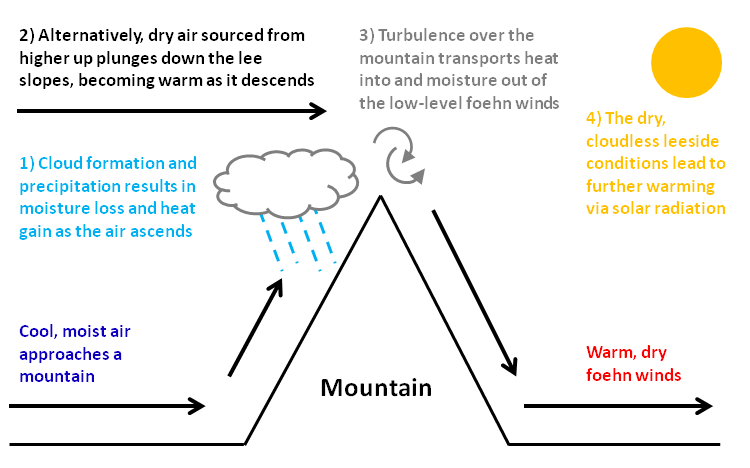 Thanks, WikiMedia!
 In many places, foehn winds have local names, such as Santa Anas in southern California and chinooks in the Rocky Mountains. As you might expect, given the spelling, we got the word from German Föhn, where it also means hair drier (!), but the wind sense was originally from Swiss German and/or Middle High German fœnne, from Old High German phonno/phōno, from (possibly via Romansh favuogn/fuogn) Vulgar Latin *faōnius, from Latin favōnius, west wind, (the Roman counterpart of Greek zephyr) which was traditionally supposed to be a mild weather and harbinger of spring -- and in Switzerland foehn are indeed associated with late winter thaws.
---L.
![[personal profile]](https://www.dreamwidth.org/img/silk/identity/user.png) immortalje posting in
immortalje posting in ![[community profile]](https://www.dreamwidth.org/img/silk/identity/community.png) dailyicons
dailyicons


